Percentage rent
Percentage rent, calculated and billed correctly.
Natural and artificial breakpoints, tenant sales recorded per period, and an annual true-up generated from what was actually reported.
14-day free trial · No credit card
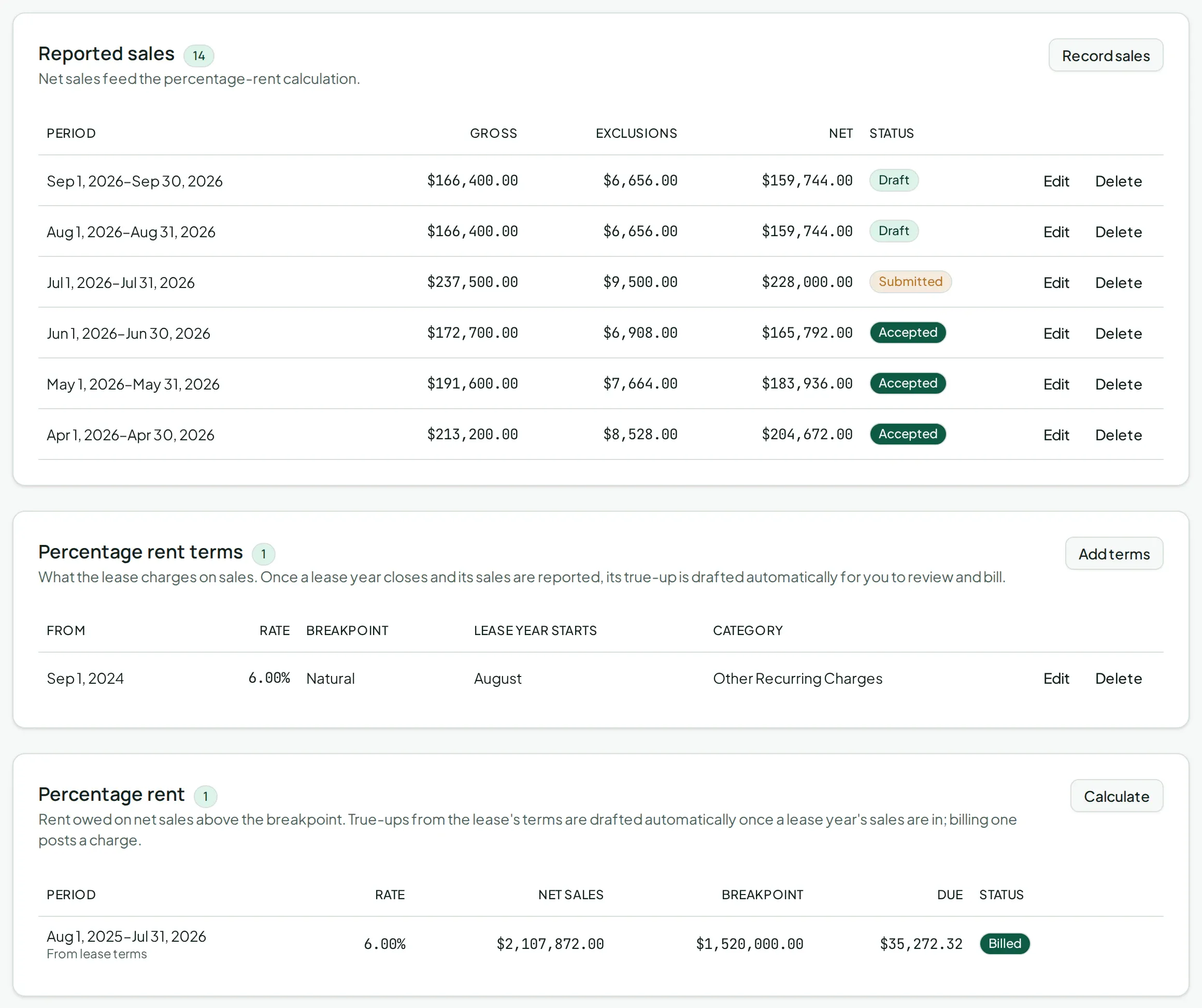
Natural and artificial breakpoints
A natural breakpoint is base rent divided by the percentage rate. An artificial breakpoint is any negotiated figure, and it overrides the natural one. Vespy derives the first and records the second on the lease.
- Natural breakpoint derived from base rent and rate
- Artificial breakpoint recorded as an explicit override
- Percentage applied only to sales above the breakpoint
Tracking tenant sales
Your team records each tenant’s reported sales per period, with exclusions and a status: draft, submitted, accepted, or disputed. When a figure is challenged later, the record is already there.
The annual true-up
The true-up is total sales, less the breakpoint, times the rate, less percentage rent already billed. Vespy drafts that charge from the recorded sales and posts it through the double-entry ledger.
Percentage rent questions
How is the natural breakpoint calculated?
Divide annual base rent by the percentage rate. At $120,000 of base rent and a 6% rate, the natural breakpoint is $2,000,000, and the tenant pays 6% of sales above it.
What if the lease specifies an artificial breakpoint?
The artificial figure replaces the natural one. Vespy stores it on the lease as an explicit override, and the true-up uses it.
Can tenants report sales monthly and true up annually?
Yes. Sales are recorded per period, and the annual true-up adds them up and nets any percentage rent billed during the year.
Does Vespy support audit rights on reported sales?
Yes, as a record. Each period keeps its sales, exclusions, and status, including disputed. Vespy does not verify a tenant’s point-of-sale data itself.
Stop reconciling in a spreadsheet.
Set up a recovery pool, abstract a lease, and run a reconciliation on the free trial.
14-day free trial · No credit card